Inside Bets and Outside Bets on a Roulette Layout
Inside bets and outside bets on a roulette layout differ in placement, coverage and payout structure, helping you read the table before choosing a wager.
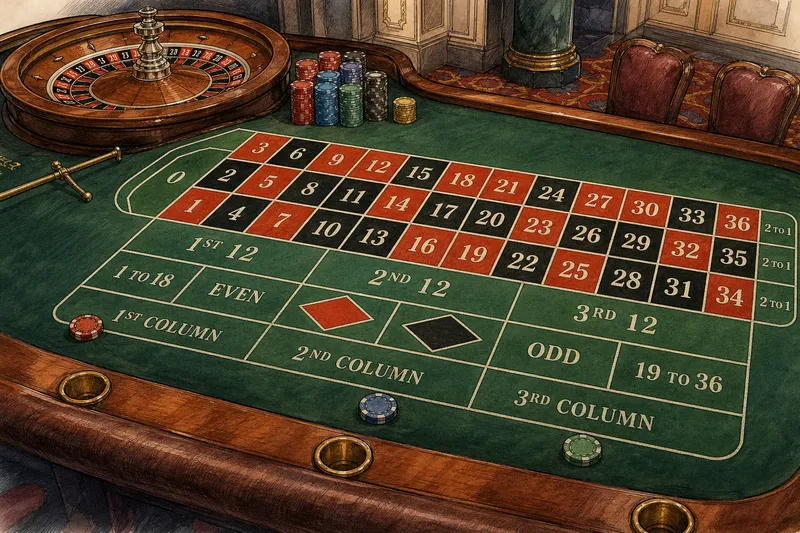
You sit down at a roulette table and find the felt divided into a crowded numbered grid and a set of boxes along its edges. Inside bets and outside bets take their names from those positions on the layout, not from separate games. Reading the two areas makes the table easier to follow, even if you decide not to place a chip.
What makes a bet inside or outside?
The numbered grid is the inside area. It contains the numbered pockets represented on the layout, arranged in rows and columns. A chip placed on a number or on a line bordering numbers is an inside bet.
The outside area holds boxes for broader groupings: red or black, odd or even, low or high numbers, and the dozen and column groups. These bets cover multiple numbered outcomes with one placement. The zero or zeros are set apart and affect which groupings can win; they are not ordinary red-black, odd-even or low-high numbers.
Roulette layouts differ by wheel type and venue. A single-zero layout and a double-zero layout do not offer the same set of numbered pockets, so the printed grid and rules at the table matter more than a familiar-looking shape.
How do inside bets sit on the grid?
Inside wagers are defined by the chip’s position relative to the numbers. A straight-up bet sits within one number’s box. A split bet straddles the line between two adjacent numbers; a street covers a row of three, and a corner covers four numbers where their boxes meet. A six-line spans two adjacent rows, covering six numbers.
Those placements can look fiddly at first because a chip may cover a line rather than a printed box. The dealer’s interpretation follows the layout markings and table rules. If the intended border is unclear, ask before the ball is set in motion; a chip placed near a boundary is a poor place to rely on telepathy.
Inside bets generally cover fewer possible results than outside bets, and their stated payouts are correspondingly larger. The exact payout is printed or posted by the venue. A larger payout does not make a result more likely; it describes how the wager is settled when it wins.
What can you choose in the outside area?
Outside bets group numbers by a shared feature rather than by a small patch of the grid. Common options include:
- Red or black: one of the two colours, excluding zero or zeros.
- Odd or even: one parity group, again excluding zero or zeros.
- Low or high: a lower or upper range of numbered pockets, as shown on the layout.
- Dozens: one of three groups, each covering a consecutive block of twelve numbers.
- Columns: one of the three vertical groupings indicated beneath the number grid.
These choices are not interchangeable. Red and black follow the colour markings; columns and dozens follow the printed arrangement. Zero falls outside the standard even-money groupings and may be handled differently under particular table rules.
Outside wagers often have more winning numbers than a single-number bet, but their payout is smaller. That comparison describes coverage and settlement, not a promise of a particular result or a reliable way to improve one.
How might you read a layout during a visit?
Say you arrive at a single-zero table and want to understand the markings before deciding whether to play. You first identify the numbered grid, then trace the perimeter boxes and read their labels. You notice that a chip centred in a number box represents a single-number wager, while one placed in a red box covers the red grouping, with zero excluded. The observable result is a clearer understanding of what each placement means; it says nothing about which result will appear.
A calm way to approach the layout over a short visit is to make the reading itself the routine:
- At the table: identify whether the wheel has one zero or more than one, then match it to the layout.
- Before choosing: read the outside labels and locate the zero area rather than assuming every number belongs to a colour or parity group.
- When looking at inside bets: follow the boundaries between boxes to distinguish a number, a split, a street and a corner.
- Before placing a chip: check the posted payout and confirm which position the dealer will recognise if the placement is close to a line.
- After the round: compare the winning number with the printed groupings to see how the result is settled, without treating one outcome as a guide to the next.
This routine takes no special equipment. The felt is the map; the important part is reading its labels rather than guessing from the chip’s apparent destination.
Which roulette bet questions come up most often?
Are inside bets riskier than outside bets?
Inside bets usually cover fewer numbered outcomes, while outside bets cover broader groups. The smaller coverage is paired with a larger stated payout, but neither placement changes the wheel’s chance process.
Is a dozen bet inside or outside?
A dozen bet is an outside bet because it is placed in a labelled box beyond the numbered grid. It covers the corresponding group of twelve numbers shown on the layout.
Does zero count as red or black?
No. Zero is green on standard roulette layouts and is excluded from red-black and other common even-money groups. The exact treatment of a winning wager when zero appears depends on the table’s posted rules.
Can a chip cover more than one number?
Yes. Inside placements such as splits, streets, corners and six-lines cover multiple adjacent numbers, while outside boxes cover larger printed groups. The chip’s position determines which wager it represents.
What should you check before placing a wager?
Take a moment to compare the wheel, the layout and the posted rules. In particular, check whether the table uses a single-zero or double-zero arrangement, how its outside groups are labelled, and what payout applies to the wager you are considering. If a rule depends on the table’s specific wording, follow the posted information or ask the dealer before betting.
Knowing the distinction between inside bets and outside bets on a roulette layout will not make roulette predictable. It does give you a useful, concrete skill: you can identify what a chip represents before the round begins, and leave the wheel to supply the uncertainty.