Casino Scenes on Screen: Atmosphere Is Not Evidence
Use this casino scenes on screen viewing checklist to separate lighting, editing and character behaviour from claims about how casino games work.
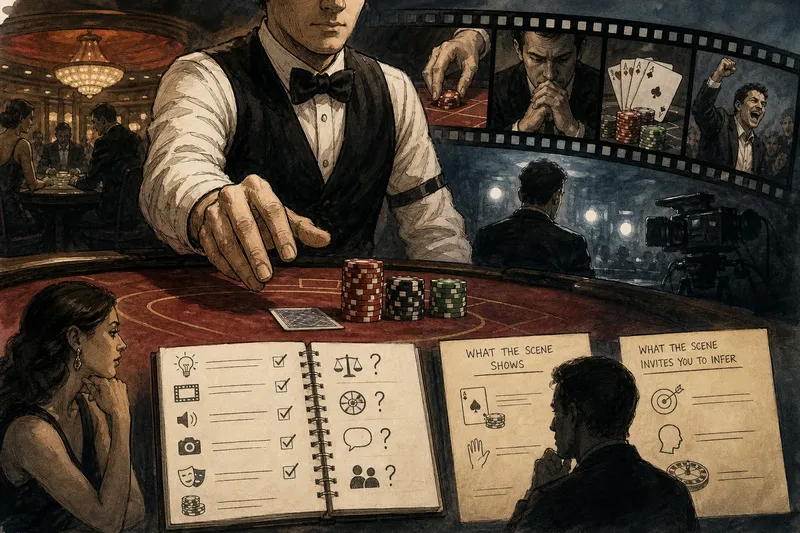
A dealer’s hand pauses above the felt while the music thins to a single note. In casino scenes on screen, that pause can make an ordinary decision feel like the hinge of a life. It tells you what the film wants you to feel; it does not, by itself, tell you how the game works.
A useful viewing habit is to treat atmosphere and procedure as separate tracks. Watch the lighting, pacing and performances for what they contribute to the story. Then inspect any factual claim about rules, odds, decisions or outcomes on its own terms. The checklist below follows that order, from the first impression to the final claim.
What is the scene asking you to feel?
Start with the scene’s emotional instructions. Is the character meant to look composed, trapped, reckless or newly confident? A low camera angle can make a table seem imposing; close-ups of chips can turn a small gesture into a declaration. A crowded soundtrack may suggest pressure, while near-silence can make a routine action seem momentous.
These are expressive choices, not neutral records. Film-makers use light, framing, sound and performance to guide attention. A polished room may suggest wealth or control; it cannot establish how a particular venue operates. Nor does a tense expression show that a player has recognised a real pattern in the game.
Note the mood before judging the mechanics. That small pause in your own viewing helps prevent the score from doing the thinking for you.
Which details are cinematic choices?
Look for the elements that are easiest to manipulate in production. They often shape the scene’s credibility before any rule is mentioned.
- Lighting: Notice whether the table is brightly lit, selectively shadowed or given a glow that belongs more to the story than to an ordinary room.
- Editing: Watch for cuts that omit dealing, decisions or the passage of time. A sequence may compress several moments into a few seconds.
- Sound: Separate the room’s background noise from added music, sharp chip sounds and amplified reactions.
- Framing: Check whether the camera shows the full table, only the character’s hands, or a close-up that hides what other players can see.
- Performance: Notice whether the actor signals confidence, dread or surprise before the result is known. That expression serves character and suspense, not necessarily game instruction.
- Props and layout: Ask whether cards, chips, signs and table markings are legible, or simply arranged to make the setting recognisable.
These details can still tell you something useful: how the film wants the casino to feel. They become weaker evidence as soon as the question changes to what a real game permits.
Does the pacing show the actual sequence?
Editing regularly removes the parts of a game that do not help a scene move. A film may cut from a wager to a result, skip a decision, or linger on a single card while omitting the rest of the table. That is narrative compression. It can make the sequence easy to follow, but it leaves gaps that matter if you are trying to learn procedure.
For a factual claim, ask what happened between the visible moments. Did the player act before or after the dealer? Was a further choice available? Did the scene show the complete round, or only the beats needed to deliver a reversal? If the film skips those details, do not fill them in from the music or the actor’s certainty.
Imagine a scene in which a character places chips, the camera cuts to a tense face, and the next shot shows a winning result. The viewer can reasonably infer that the edit presents a wager followed by a win. The cut does not establish which options the player had, how the wager was settled, or whether the film has omitted intervening actions. Those questions need visible rules, clear dialogue or a separate factual source.
Is a character’s confidence being treated as proof?
Screen characters often explain games in the voice of people who cannot be interrupted. Their claims may be accurate, partly accurate, mistaken, or designed to persuade another character. Listen for the difference between a rule and a boast.
A statement such as “I know what comes next” is a character’s belief. A specific explanation of what actions are allowed is a claim about procedure. A line that says a certain result is due because it has not appeared recently is a claim about chance. The film may want all three to sound equally authoritative; the viewer does not have to accept that arrangement.
Check what the scene itself supports. Does it show the relevant action clearly? Does another character challenge the explanation? Is the speaker trying to sell a system, impress someone or hide a mistake? Motivation does not settle whether a claim is true, but it helps identify when dialogue is serving drama rather than instruction.
What should you check in casino scenes on screen?
Does the film show the rules before the result?
Look for a clear account of the relevant choices, turn order and way a result is decided. If these are missing, treat the outcome as a story beat rather than a demonstration of the rules.
Can you see what each player does?
Check whether the camera shows the actions that matter, including any decision or dealer action. Close-ups and reaction shots may hide information that would be needed to follow the round.
Is the character describing a rule or a strategy?
A rule describes what the game allows or how it resolves an action; a strategy is a proposed way to choose. A confident strategy can be mistaken, and a dramatic scene does not establish that it works.
Does the scene present chance as a pattern?
Notice whether a character treats earlier outcomes as a promise about the next one. The scene may be portraying a belief, a scheme or a misunderstanding rather than stating a reliable feature of the game.
How do you separate a game claim from a story claim?
Sort what you have seen into two columns. The first is what the scene directly shows: a player makes a choice, a dealer reveals something, or a character reacts. The second is what the dialogue, editing or mood invites you to infer: a particular choice caused the result, a player predicted it, or the venue favoured one person.
Then ask whether the inference follows from the visible action. If a player wins after announcing a plan, the sequence establishes that the win followed the announcement. It does not establish that the plan caused the win. The edit may have removed other events, and the scene may have selected this outcome because it advances the plot.
This distinction is especially useful when a film depicts a “system”. A named approach, a table ritual or a character’s careful bookkeeping can make the idea look methodical. Methodical presentation is not evidence that chance has become predictable. The story may be depicting conviction, not validating it.
What can venue design tell you?
A set can suggest how a casino feels without accurately representing how a particular venue is arranged. A long corridor, an isolated table, a view of a stage or a tightly packed room may be chosen to guide the character and camera. In a film, the geography of a space is often as much a storytelling device as a physical setting.
Separate description from implication. “The scene shows a table beside a bar” is a description. “The casino places the table there to keep players at it” is an explanation of purpose, and it needs evidence beyond the shot. A fictional layout can be plausible without being typical, and a recognisable visual detail can be included for shorthand rather than accuracy.
For a real-world claim about a venue, look for information tied to that venue rather than relying on a fictional scene. The film may offer a useful impression of spectacle, privacy or social pressure, but it is not a floor plan.
How should you judge a scene that feels authentic?
Authenticity is often built from small, familiar details: the sound of chips, a dealer’s rhythm, a sign behind the table, or the way a player waits before acting. When those details feel convincing, the larger sequence can inherit their credibility. This is a craft effect, not a certification.
Ask what kind of authenticity the scene offers. It may be emotionally convincing, visually plausible or procedurally accurate; those are related but distinct qualities. A scene can capture the unease of making a decision while simplifying the rules. It can also reproduce a familiar table layout while giving a character an implausible advantage for dramatic reasons.
Use the same standard for flattering and unflattering portrayals. A glamorous casino is not proof that play is effortless or consequence-free. A grim one is not proof that every venue or game shares the same conditions. Mood is evidence of the film’s point of view.
What is the final viewing check?
Before carrying a claim out of the cinema, run through these questions in order:
- What did the camera actually show? Describe the visible actions without adding an explanation.
- What did the edit omit? Note any missing decisions, dealing or time between actions.
- Who made the claim? Distinguish a character’s opinion from a clear explanation of a rule.
- What is the claim about? Separate game procedure, venue design, strategy and chance.
- What would count as support? For procedure, look for the rules of the specific game. For a real venue, seek information about that place. For a claim about chance, do not treat one dramatic sequence as a general pattern.
- What remains uncertain? Keep that gap open instead of letting an intense close-up fill it.
The point is not to watch every casino scene with a notebook in hand. It is to recognise when a film is making you feel that a character has control, then ask whether the scene has shown anything beyond that feeling. Casino scenes on screen can be excellent at suspense and selective about facts. Enjoy the suspense; let the rules earn their own credibility.